
Hybrid CVT Information and Safety
A detailed guide to Nissan hybrid CVT systems in the X-Trail NT32 4WD Hybrid (MR20) and Pathfinder Hybrid. Learn how hybrids differ from standard CVTs, why it changes servicing, where the high voltage battery sits, how isolation works, inverter risks, and what can happen if procedures are skipped.

February 26, 2026
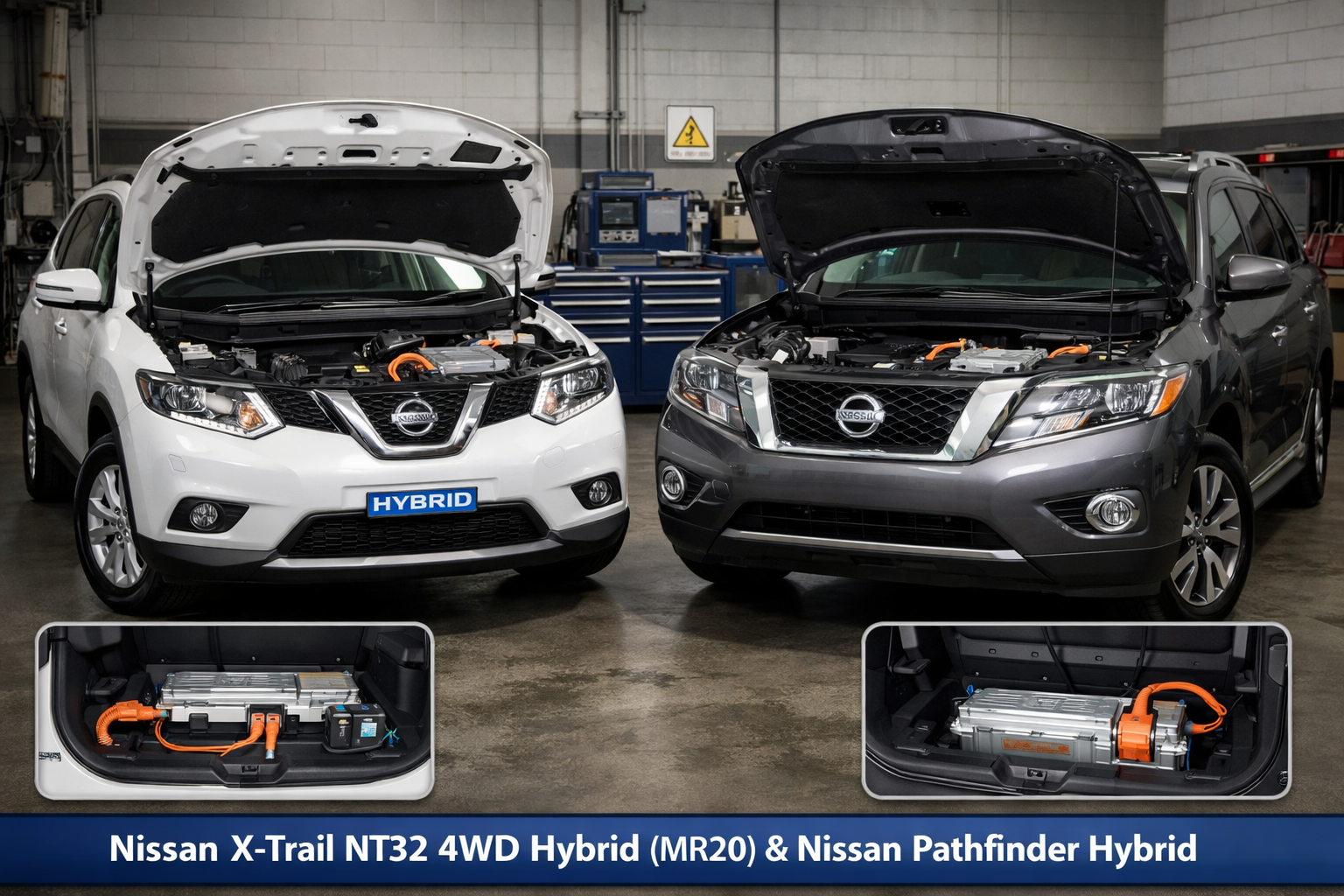
Table of contents
Nissan X-Trail NT32 4WD Hybrid (MR20) and Nissan Pathfinder Hybrid
If you drive a Nissan hybrid that has a CVT, it can feel like “just another automatic” from the driver’s seat. In a workshop, it is very different.
The reason is simple: a hybrid has two power sources and a high-voltage electrical system. That means your car can be “quiet” with the petrol engine stopped, yet the drivetrain can still be live and capable of moving. Nissan warns that if the READY to drive indicator is on, the vehicle can move even if the engine is not running.
This guide explains, in plain language, what makes hybrid CVT systems different, why that matters for servicing, and the key high-voltage safety steps workshops must follow.
Nissan X-Trail NT32 4WD Hybrid (MR20)
What it is and what owners should know
The X-Trail NT32 Hybrid pairs the MR20 petrol engine with an electric motor and a lithium-ion traction battery. The hybrid system is designed to recover energy during driving and braking, and then use that stored energy to assist acceleration and low-speed driving.
High voltage, and why it matters
In the X-Trail Hybrid owner information, Nissan states the hybrid system uses high voltage up to approximately 235 volts.
That is more than enough to cause severe injury. It is also why hybrid vehicles have strong warnings around orange cabling and high-voltage connectors.
Battery area and cooling
Nissan also highlights that the luggage room has a dedicated cooling air path for the lithium-ion battery and related components, and warns not to block it because overheating can reduce hybrid performance.
For owners, this is a practical reminder that the rear of the vehicle is not just storage space. It is also where hybrid components may be packaged and cooled.
Nissan Pathfinder Hybrid
What it is and what owners should know
The Pathfinder Hybrid uses a high-voltage traction battery and an electric motor integrated into the drivetrain. It runs two electrical systems side by side:
- A normal 12V system for lights, audio, and standard vehicle electrics
- A high-voltage system for electric drive and hybrid operation
High-voltage battery location
For the Pathfinder Hybrid, Nissan’s emergency response guide describes the high voltage battery as being located in the rear cargo area, packaged under the third row seating area and concealed by trim.
It also describes a service plug access point in the cargo floor storage area, used to help disable the high voltage system.
High voltage level
The same guide lists the Pathfinder Hybrid high voltage battery as 144V DC.
What a hybrid system is, and how it differs from a standard CVT
A standard CVT vehicle
A normal CVT vehicle has one power source, the engine. The transmission varies its ratio smoothly using pulleys and a belt or chain. If the engine is off, there is no drive torque being produced.
A hybrid CVT vehicle
A hybrid adds:
- A high-voltage battery (traction battery)
- An inverter and control electronics
- An electric motor that can drive the vehicle and recover energy during braking
The inverter’s job is to manage the flow of electricity, converting battery power into the type of power needed by the motor, and controlling charging during regenerative braking.
This is the big difference: the drivetrain can still be active even when the petrol engine is not running, because the electric motor can provide drive. Nissan explicitly warns not to assume a hybrid is shut off just because it is quiet.
Key differences and why they matter for servicing
1) “READY” matters more than “engine running”
In a hybrid, the safe question is not “is the engine running?” it is “is the vehicle in READY?”. READY indicates the high-voltage system may be active and the vehicle can move.
Why it matters to you: This is one reason hybrid servicing often includes extra checks and stricter workshop control of keys and vehicle state.
2) Hybrid components sit alongside normal mechanical parts
In a standard CVT service, much of the work is mechanical: fluid condition checks, leaks, mounts, driveline noise, and transmission control module scan data.
In a hybrid, the transmission area and engine bay may also be near high-voltage components, orange high-voltage cables, and power electronics. That changes how technicians approach even “routine” jobs, because parts that look like normal wiring are not safe to handle the same way.
3) The inverter can stay dangerous after shutdown
One of the most important differences is stored electrical energy. Nissan notes that the inverter contains a high-voltage capacitor.
Even after the vehicle is shut down, guidance repeatedly states that you must wait about 10 minutes for the high-voltage capacitor to fully discharge before touching high-voltage connectors or terminals.
Why it matters to you: this waiting period is real workshop time, and it is there to prevent serious injury.
4) Battery cooling and rear trim areas can affect performance
On the X-Trail Hybrid, Nissan warns that blocking the battery cooling vent can overheat the battery and reduce hybrid performance.
So a “reduced hybrid power” complaint is not always a simple transmission issue. It can relate to battery temperature control, airflow, or system protection behaviour.
Safety procedures when working on hybrids
Including 450V high voltage battery location, battery isolation, inverter awareness, and risks
Hybrid and EV high-voltage systems vary widely. Some Nissan systems, such as certain e-POWER models, are documented as using high voltage up to roughly 420V, which is in the same “400 to 450V class” people often refer to.
For the specific vehicles in this blog, Nissan documentation states around 235V for the X-Trail Hybrid and 144V for the Pathfinder Hybrid.
The key point for owners is not the exact number; it is that high voltage is potentially lethal at any of these levels, and the safety process must be followed every time.
1) High voltage battery location
Owners do not need to access these components, but understanding why certain areas are treated carefully helps.
- X-Trail NT32 Hybrid: Nissan states that the high-voltage service plug is in the luggage room area and identifies the hybrid high-voltage components and orange harnesses as dangerous.
- Pathfinder Hybrid: Nissan describes the high-voltage battery as housed in the rear cargo area under the third-row seating area, with a service plug accessible from the cargo-floor storage area.
2) Mandatory battery isolation
Before any work near the hybrid high-voltage system, the workshop should power the vehicle down correctly and isolate it so the high-voltage system cannot energise unexpectedly.
This typically includes actions like:
- Confirm the vehicle is not in READY, and keep keys away from the vehicle
- Use the manufacturer-defined service disconnect method (service plug, where applicable)
- Isolate the 12V system as part of the shutdown process, because the vehicle uses both 12V and high-voltage systems
- Apply clear control of the work area so nobody reconnects or powers up the vehicle mid-repair
A professional shop will treat isolation as a checklist process, not a judgment call.
3) Inverter disconnection awareness
The inverter is one of the most dangerous parts to treat casually.
Nissan explains that the inverter contains a high-voltage capacitor.
Because capacitors store energy, the system can still be dangerous after shutdown. That is why multiple Nissan-related safety documents stress waiting at least 10 minutes after shutdown or service plug disconnection before touching high voltage connectors or terminals.
4) Risks if the correct procedures are not followed
The consequences are serious, and Nissan’s own warnings are blunt:
- Severe electric shock and burns: Nissan warns that touching high voltage parts, harnesses, connectors, or the service plug can cause severe burns or electric shock, resulting in serious injury or death.
- Unexpected movement: The vehicle can move if it is in READY, even with the engine not running.
- Damage and secondary hazards: Poor handling of high-voltage components or ignoring cooling airflow guidance can lead to system faults, reduced performance, and potentially expensive component damage.
What this means for you as an owner
If your hybrid CVT vehicle needs diagnostics or servicing, it is normal for the job to involve:
- More safety steps before work even begins
- Additional system scanning of hybrid modules, not just the transmission
- Extra time allowances for safe discharge and verification
- Strict handling rules around rear cargo areas where hybrid components may be packaged
Common owner complaints in hybrids (judder, squeaks, low power)
Common hybrid problems can include a lack of power when taking off in reverse or drive, plus noises when the vehicle switches between electric and petrol power. You might also notice a slight judder during that changeover.
Hybrids are not always well-suited to constant, slow, stop-start driving. In heavy traffic, the battery may not get enough opportunity to recharge properly. If you continue driving with a low battery state of charge, it can contribute to symptoms like juddering or even a squeaking noise when the system switches between the petrol engine and electric drive.
One way to help is to take the vehicle for a longer drive a couple of times per week, around 100 km or more, so the battery has time to recharge fully.
This matters even more in New Zealand because many hybrids are imported from Japan and may already be 10 years old or more. As batteries age, they typically do not perform as strongly as they did when new.
If any warning lights come on, it is best to have the vehicle checked as soon as possible. Hybrids can have 15 or more control units that communicate with each other, and a fault code in one system can sometimes affect how other systems behave.
Closing thoughts
Hybrid CVT vehicles like the Nissan X-Trail NT32 Hybrid (MR20) and Pathfinder Hybrid are designed to be smooth and efficient, but the technology that makes them feel effortless on the road is exactly what makes them different in the workshop. Even when the petrol engine is silent, the vehicle can still be in READY, and the high voltage system can still be active, which is why trained technicians treat every hybrid as live until it has been properly isolated and verified safe.
If you are booking your vehicle in for CVT or hybrid-related work, the safest choice is a workshop that follows the correct shutdown process every time, understands where the battery and service disconnect are located, and respects inverter discharge time before touching any high voltage connectors. Those steps might add time to the job, but they protect people first, and they also prevent costly damage caused by rushing or guessing.
The takeaway is simple. Hybrids are not “just a CVT with a battery”. They are a drivetrain and an electrical system working together, and they need the right procedures, tools, and experience to service safely. If you are ever unsure, ask your workshop what hybrid safety steps they follow and whether they allow time for high voltage discharge. A good shop will be happy to explain, because safety is part of the service.
- By
- CVT Team
Share this post